Workshop: Microsatellites and their use in planetary and astrobiology research

Running in Tartu (Estonia) from the 1st to the 8th of August 2023, this workshop will enable students and early career scientists to design micro- and nanosatellite missions tackling scientific themes and target objects they have chosen themselves previously. The workshop will consist of three parts:

  • a lectured part consisting of in-depth talks on the scientific background of the chosen mission themes and on important issues in satellite technology
  • a mission designing part where attendees plan these endeavours in detail with the help of satellite technologists
  • a final presentation of all the projects

In order to plan missions involving such small satellites successfully, intensive interaction and cooperation between scientists and space technologists are necessary, which is still lacking in some potential key applications. The workshop school aims to:

  • Highlight the possible potential of microsatellites in exploring different targets like the Moon, small bodies and outer satellites
  • Foster the interaction between space researchers and technologists
  • Allow participants to start the design and planning of new space missions
  • Contribute to the training of a new generation of space researchers

The work on the mission designs will continue after the workshop, thus ensuring a long-term impact.

The European Astrobiology Institute, University of Tartu and Stockholm University Astrobiology Centre will function as co-organisers of the workshop.

The workshop will consist of lectures by leading scientists, planning for different micro- or nanosatellite projects in small groups, as well as open discussions. Participants will also have the possibility to display their own research results in a poster session. Furthermore, a one-day excursion to South Estonia and a walk around Tartu are included as a social programme.

For further information, please check the website.

Conference “Life in the sub-surface”

The meeting “Life in the Sub-Surface: Habitats, species, metabolism and survival strategies” organised by the EAI will take place in Angra (in the Azores Islands, Portugal) from the 25th to the 27th of October 2023. It will focus on the following subjects:

  • Characteristics of (potential)  sub-surface habitats on Earth and beyond
  • Early evolution of subsurface life including its possible role in emergence of life
  • Diversity, metabolism and survival strategies of subsurface life on Earth
  • Possibility of extraterrestrial subsurface life and its detection
  • Gaps in the knowledge about subsurface life
  • Subsurface environments and extremophiles on the Azores.

 It will be held at the very modern Centro Cultural e de Congressos offering
ideal setting. The location Angra (in the Azores Islands, Portugal) is a picturesque city and has plenty of good restaurants and clean and affordable hotels with good
services.

The EAI project team “Astrobiology and Art” will organise a multimedia event on the first day. The speleological society “Os Montanheiros” will organise an exhibition of life in Azorean lava caves.

 >> The deadline for registration and abstract submission is July 1st,
2023 <<

Please check the website for more info.

Summer school “Volcanism, Plate Tectonics, Hydrothermal ventsand life”

The summer school organised by the EAI will focus on which role volcanism, plate tectonics and hydrothermal vents played in the emergence and evolution of life.
There will be lectures by leading scientists in the field, sampling excursions to lava caves and solfatares, exercises on the genetic characterisation of
extremophiles populations
in those habitats, as well as on cultivation of
bacteria
.

The summer school will take place in Angra (in the Azores Islands, Portugal) from the 11th to the 21st of October 2023. There
are flights to the close Terceira Lajes airport from both Europe
mainland, the US and Canada.

The summer school will include:

  • Lectures by leading scientists in the field covering a cornucopia of different subjects
  • Field excursions to geologically interesting sights (volcanic areas, hot springs, lava caves, etc.)
  • Exploration of lava caves
  • Characterisation of microbes in lava caves and hot springs via Polymerase chain reaction (PCR)
  • Poster sessions
  • Participant-led discussions

 >> The deadline for applications is July 1st, 2023 <<

Please check the EAI website for more info

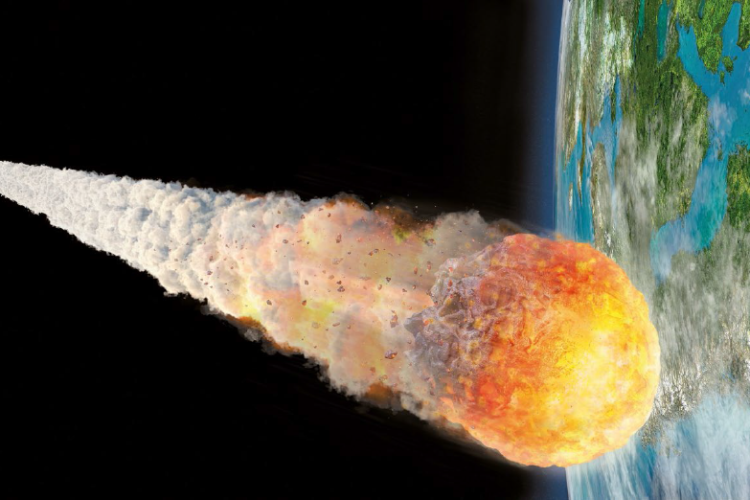
Summer school “Impacts and their Role in the Evolution of Life”

The course organised by the EAI will give the participants a thorough introduction into
how meteorite, comet and asteroid impacts participate in shaping
life on Earth
. The following subjects will be covered by the lecture:

  • Roles of impacts in the formation of habitable planets
  • Physical and chemical properties of comets and meteorites
  • Detection and investigation of impact craters by geological meth and remote sensing from space
  • Ecological consequences of impacts and the role of impacts in mass extinctions
  • Transfer of life through meteorite impacts
  • Threat of life on our planet by near-Earth asteroids and comets

The lecture programme will be complemented by practical exercises concerning:

  • Investigations of Suevite formations
  • Analysis of pollen indicators impacts events.
  • Microscopy of impactites
  • Outreach work for a conference on “Impacts and their role in the evolution of life” in Nördlingen in autumn 2024

 The summer school will be held in Nördlingen (Germany)the centre of the Ries Crater impact, from the 5th to the 14th of September 2023.

Lectures will cover a cornucopia of subjects ranging
from properties of impactors, physics of impacts, ecological
consequences of impacts, impact geology to impacts on Mars. Exercises
will comprise geological field studies at the Ries and the
neighbouring Steinheim crater as well as palynological and
petrographic microscopy studies.

Many leading scientists will teach a
the school.

Bursaries are available for students and early-career scientists.

Nördlingen is a very nice medieval city situated on the
“Romantic Road” with an intact city wall and offers good
accommodation and meals. It is easy to reach from the international
airports from Munich and Frankfurt as well as by train.

 >> The deadline for applications is 15 June 2023 <<

Please check the EAI website for more info

Postdoctoral position in Analytical Chemistry/Geochemistry at the Institut Origines in Marseille (France)

Applications for a postdoctoral position to work on molecular evolution related to post-impact processes generated after interplanetary bodies impact of the early Earth is open, between the ASTRO’team of the PIIM laboratory and the Evolution of Bioenergetics’team of the BIP laboratory at Aix-Marseille University, Institut Origines, Marseille, France.

The main task will consist in developing experiments simulating sub-surface environments, to understand how molecular diversity as observed in some meteorites could evolve once delivered at the surface of the early Earth. Environments to simulate will concern hydrothermal alteration in subsurface
allowing organic interactions with minerals and UV photons.

These experiments will address the hypothesis of an exogenous supply of organic matter via interplanetary bodies on telluric
planets, and its potential role in the emergence of prebiotic chemical systems. G. Danger, V. Vinogradoff (PIIM) and S. Duval (BIP) will supervise this position.

Organic and mineral production will be developed at the BIP and PIIM laboratories, and sample analyses will be performed using spectroscopic technics (GC-MS, FT-IR) and in collaboration with the CINAM laboratory (expert in imaging methods).

The candidate will work in an interdisciplinary environment which will give him the opportunity to extend their knowledge. This project is part of the interdisciplinary research project EXOMIOLE supported by the “Institut Origines” and funded by the A*MIDEX Excellence program of Aix-Marseille University, and gathering several close laboratories in astrophysics (LAM), geology (CEREGE) and human sciences (CGGG).

The position is for one year, renewable for a second year upon mutual agreement. The starting date would be between autumn and the end of 2023, depending on the applicant’s availability.

Candidates must have a PhD in chemistry, physico-chemistry, geochemistry or in analytical chemistry by the date of appointment. Applicants should submit a cover letter, CV, list of publications, and a statement (2 pages max) explaining research interests and qualifications, and arrange for two letters of recommendation. Review of applications will begin upon receipt until the position is filled and all applications received by the deadline will receive full consideration.

Application Deadline: July 15th, 2023
Attention To: Grégoire Danger, Simon Duval and Vassilissa Vinogradoff
Email for more info: gregoire.danger@univ-amu.fr, sduval@imm.cnrs.fr, vassilissa.vinogradoff@univamu.f

AbGradEPEC 2023 is in almost 1 week!

We are really looking forward to finally having this long-awaited event in La Palma🌴

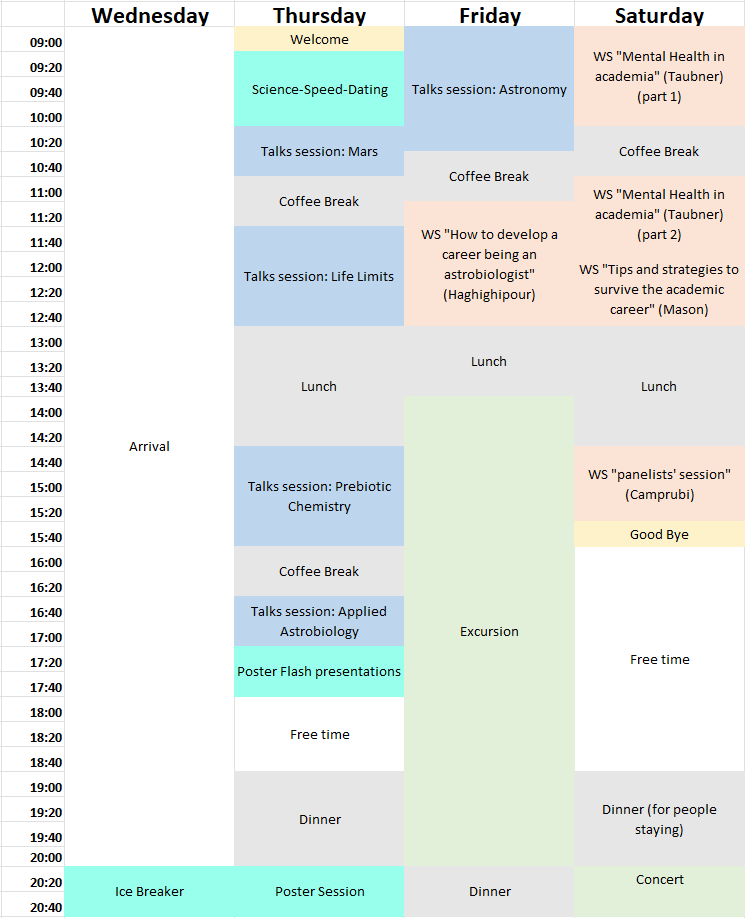
Here is the programme, packed with interesting talks, workshops and fun activities:

All participants should expect one last email from us with more practical details and the Symposium Booklet📖

We’ll see some of you soon, and hopefully we’ll be able to meet those who couldn’t join us this time at our next events!

Group Coordinator position in leading theory group focused on the physics of life, alien life, and origins of life at the Arizona State University

Work with Professor Sarah Walker, principal investigator (PI), in managing her research group, through day-to-day supervision of research assistants, preparing and editing manuscripts, project and lab management while making a leading contribution, in liaison with the PI, in submitting grant proposals.

Main task: 60% of time involves leading coordination of a large multi-partner, multi-center world leading research group, and participation in developing high level research together with team and subgroup leaders. The person will also take part and receive training in the front-line research activities of the group for the other 40% of time.

The position is ideally suited for transitioning from a postdoc/tech position to learning to run a theory group, with the opportunity to lead science efforts to advance understanding of what life is.

📅Closing date: 5th May – 3:00pm MST(GMT-7)📅

For more info on the position click here, while here you will find full details and information on how to apply.

Earth Science Women’s Network (ESWN) Events

The ESWN has two events planed that might be of interest to you!

1 – ESWN Academic Faculty Interviews Event

Are you considering applying for a faculty position in the USA? Would you like to learn about the interview process, what you should prepare for, what to expect, and who you will meet?

The Earth Science Women’s Network will be hosting a webinar on April 18, 2023, from 16:00 – 17:30 UTC to answer all these questions and many others. A panel of assistant professors & professors within multiple earth science disciplines will share their experiences and “lessons learned”, and answer your questions. This workshop is geared towards graduate students and postdoctoral researchers considering an academic career in the USA.

You will be joined by:

  • Rachel Bernard (Assistant Professor, Amherst College)
  • Courtney Hatch (Professor of Chemistry, Hendrix College)
  • Jessica Haskins (Assistant Professor, University of Utah)
  • Gaia Stucky de Quay (Assistant Professor, MIT)

Panellist biographies are available here.

There will also be an opportunity to network with the speakers after the panel discussion.

> Register here <


2 – ESWN Navigating a Workplace Hierarchy Event

Have you experienced hierarchy in your workplace? Unsure how to navigate it?
Registration is now open ESWN’s upcoming event on Friday May 19th at 15:30 UTC!

You will be joined by 5 fantastic speakers who will share their experiences & provide insights on what to do: 

  • Emma Dunne (Friedrich-Alexander-Universität Erlangen-Nürnberg, Germany)
  • Sophie Laurie (Somerset Wildlife Trust, UK)
  • Elena Miranda (California State University Northridge, United States of America)
  • Amanda Obidike (STEMi Makers of Africa, Nigeria)
  • Luan Heywood (International Ocean Discovery Program, United States of America)

Panellist biographies are available here.

> Register here <


If you have any questions about ESWN’s events, you can email them at events[at]eswnonline[dot]org

Two fully funded PhD positions at the University of Kent

You can now apply for two fully-funded PhD studentships in Astronomy and Planetary Science at the Centre for Astrophysics and Planetary Science (CAPS), University of Kent, starting in September 2023!

The group consists of 8 academics and 20 postgraduate students with research interests covering Solar System and Space Science, the Interstellar Medium, Star Formation, Galactic Structure, Astrochemistry and Astrobiology. 

There are four projects that are being offered on a competitive application process:

More details can be found here. Potential applicants are strongly encouraged to contact prospective supervisors to discuss the research project before they apply. 

📅 The application deadline is Sunday April 23rd 2023 📅

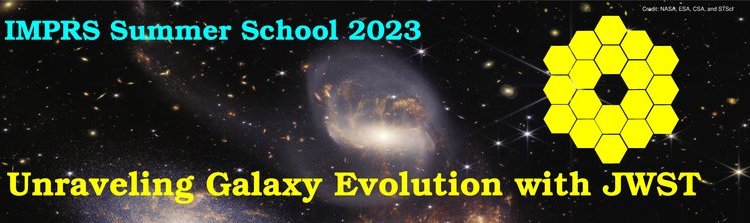
18th Heidelberg Summer School – Call for Applications

The “International Max Planck Research School for Astronomy &
Cosmic Physics at the University of Heidelberg
” (IMPRS-HD)

announces the

>> 18th Heidelberg Summer School <<
“Unraveling Galaxy Evolution with JWST”

The school is organized for early-career scientists and will take place on September 4 – 8.

It will focus on the most relevant aspects of galaxy evolution addressed by JWST, from nearby to the most distant galaxies.
JWST revealed surprises from its first images and is already
revolutionizing many fields of astrophysics.

The school will give the participants an overview of what we have learned about galaxy evolution in the first year of JWST observations, the emerging challenges, and the opportunity to work with JWST data guided by world-renowned experts.

The topics include an overview of JWST, the physics of nearby galaxies, the role of AGN feedback, the cosmic noon, and the high-z Universe.
The lectures will be accompanied by hands-on sessions and talks highlighting recent scientific results.

Invited lecturers are:

Steve Finkelstein (Univ. Texas Austin)
Adam Leroy (Ohio State Univ.)
Nora Lützgendorf (ESA)
Alice Shapley (UCLA)
Andrey Vayner (Johns Hopkins Univ.)

Hands-on session tutors are:
James Davies (MPIA)
Oleg Egorov (ARI)


The school SOC is:
E.Banados (MPIA), L.Boogaard (MPIA), F.Davies (MPIA), A.de Graaff (MPIA),
I.Momcheva (MPIA), N.Neumayer (MPIA), D.Wylezalek (ZAH)

>> Deadline for applications is June 15, 2023 <<