Help the Earth Science Women’s Network understand more about the mentorship needs of the community

This survey is being administered to identify gaps in mentorship opportunities, the corresponding needs and challenges of the Earth Science Women’s Network ESWN community, and to help future development of ESWN mentoring activities. These activities would include workshops, professional development opportunities, leadership opportunities, or development of a mentorship and/or mentoring education program.

They want to learn about your mentoring experiences, both formal and informal. Mentoring is defined as a relationship between someone less experienced in some area (the mentee) and someone more experienced in that area (the mentor) who shares their knowledge of the subject.

They are seeking responses from women in the earth and environmental science community who consider themselves mentors, mentees, or both. 
Please take 10-15 minutes and complete the survey.

Deadline to complete the survey is Feb. 16, 2024 (extended from February 9 2024).
If you have any questions, please email Mimi Hughes (Co-Chair of Member Engagement, ESWN Associate Board of Directors)
PhD project “FLow / ExocUbe expeRiments of Life bioSignaturEs preservation in saLts” between Paris and Bordeaux (France)

PhD position starting in autumn 2024 offered between the National Museum of Natural History in Paris (PI A. Kish) and the Institute of Condensed Matter Chemistry of Bordeaux (PIs A. Cario and S. Marre), for the project Fleur de Sel (FLow / ExocUbe expeRiments of Life bioSignaturEs preservation in saLts).

The project aims to study the conservation of biosignatures in halites, combining in situ approaches (ExocubeHalo – ISS) and in the lab using microfluidics (developed at ICMCB).

This PhD project will be co-funded by both CNES and PEPR Origines (French Research Agency), thus, the application process is in two stages: first on the CNES website (the deadline is March 15th, click here), and then the successful candidate will be selected for the other funding of the project.

For more details, click >>here<<

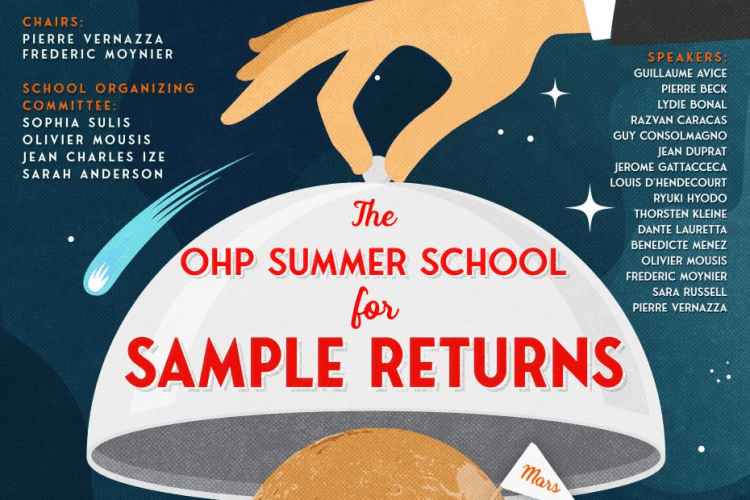
Summer School for Sample Return

This summer school, run by the Institut Origines at Aix-Marseille University and the Origins theme from the Institut de Physique du Globe de Paris, will provide a unique platform to access both basic and cutting-edge knowledge related to the study of the origin of terrestrial planets and life based on the analysis of extraterrestrial samples in Earth laboratories.

There will be a particular focus on recent and future sample return missions. This multidisciplinary summer school will address domains including cosmochemistry, astrobiology, astrophysics, planetology, and more. You will learn through lectures and practicals from our large set of world experts as well as from more informal exchanges through a series of round tables with dedicated topics.

When: 24-28 June 2023
Where: Observatoire Haute-Provence, France

Click here for more information. 

Workshop: Earth and Planets Origin and Evolution

Registration and abstract submission are now open for the workshop on the formation and evolution of Earth and of the terrestrial planets, which will take place at the Natural History Museum in Paris on May 13-17, 2024.

>> Deadline for registering: February 15th <<

You can visit the page of the workshop here for more information. 

Summer school Exoplanets by the Lake II: Geoastronomy

Exoplanets by the Lake II: Geoastronomy is a focused summer school on the geosciences of exoplanets at Lake Ammer (Ammersee), July 21—26 2024.

The distinctive features of the summer school include:

  • Emphasis on in-person interaction at an attractive, self-contained venue with at most 20 participants. The number of participants is kept small in order to encourage unrestricted, interactive discussions among exoplanet scientists of all sub-disciplines and seniority.
  • The event will be held for 5.5 days (5 nights). The first 3 weekdays involve pedagogical lectures during the day. There is an optional half-day excursion, via ship on the lake. The last 2 days feature a mini-conference format, where a small number of invited experts share their views and interact with the participants. Participants have the chance to contribute short talks if desired.


The intended audience of this summer school ranges from master students to junior postdocs. Both experts and curious newcomers to the topic are welcome to attend. Senior scientists who are intending to switch research directions and/or attending as active listeners are also welcome.

>> Deadline for registering: March 31st <<

You can visit the page of the school here for more information. 

3-year postdoc position in Origins of Life research at the Aix-Marseille University (France)

The aim of this position is to built, under the supervision of Pr. Grégoire Danger and in collaboration with Dr. Robert Pascal, Dr. Louis Le Sergeant d’Hendecourt, and Dr Vassilissa Vinogradoff, a chemistry lab dedicated to prebiotic chemistry
experiments
.

The research will be carried out within the ASTRO team at the Physique des Interactions Ioniques et Moléculaires (PIIM) laboratory of the Aix-Marseille University
in France. This team is part of the Origins Institute of the Aix-Marseille University.

Application Deadline: February 15th, 2024
Starting date: June, 2024
End Date: June, 2027

>> Click here << for details on the role and how to apply.

For further information, please contact Grégoire Danger.

Funded Mars PhD studentship at the CNRS in Orléans (France)

The objective of the project “Study of the degradation of biosignatures under Martian irradiation” is to evaluate the effect of irradiation of galactic cosmic rays during several billion years on fossiliferous Mars analog rocks and the protective effect of different minerals on molecular biosignatures. This is highly relevant for the ExoMars mission to estimate the depth at which various biosignatures of interest may be preserved, depending on the mineral matrix.  These samples will be exposed to proton irradiation at the CEMHTI Pelletron (CNRS, Orléans), where the PhD student will have direct access to the accelerator.

For more details on the position, click >>here<<
For more information about the topics and the co-financial partner, contact PI Frédéric Foucher

>> Deadline: 15th of March 2024 <<

EAI online seminar: How life-like functions can emerge spontaneously in chemical networks

Sijbren Otto, University Of Groningen Centre For Systems Chemistry, Stratingh Institute, The Netherlands

Tuesday, 6 February 2024, 16:00 CET (15:00 UTC)

Abstract: While a lot of research is devoted to the search for the chemical building blocks of life in prebiotic settings, relatively little attention has been paid to how the functions of life can emerge from mixtures of lifeless molecules. In this seminar I will introduce you to simple mechanisms through which several functions, that are deemed essential to life, can emerge from simple chemical reaction networks. These functions include self-replication, followed by catalysis and how this can lead onto a primitive metabolism. Catalysis can also yield cell-like compartments to house the self-replicators. Under the right conditions the resulting systems can undergo rudimentary Darwinian evolution and exhibit life-like behavior, including niche partitioning and eco-evolutionary dynamics

The talk will be streamed at: https://us06web.zoom.us/j/6631204351

Watch the trailer at: https://youtu.be/OQmH33FU5uY

UK Space Agency-funded Mars PhD studentship at the Open University (Milton Keynes, UK)

Full 4 year funding for this studentship has already been obtained from the UK Space Agency – It will provide an early-career scientists with the key scientific and analytical skills relevant to the NASA/ESA Mars Sample Return initiative – It involves the isotopic investigation of samples that are known to be derived from the surface layers of Mars – Provides an opportunity to develop new analytical techniques relevant to martian meteorites and returned martian samples.

Details on the project can be found >>here<<, and details on how to apply for this studentship are given >>here<<

>> New deadline: 15th of March 2024 <<

Interviews will take place the week commencing 25th March. For informal discussions about the project please contact Richard Greenwood

UK Space Agency-funded Mars PhD studentship at Imperial College (London, UK)

This studentship will investigate Kasei Vallis, the largest outflow channel on Mars and one of the largest channels in the Solar System, and is believed to have been formed by catastrophic megaflooding. The student will use the latest, high-resolution orbital remote sensing datasets to construct a detailed geological history of Kasei Valles, which could provide essential insight into the drying climate of Mars. The student will also become affiliated with and provide operational support to two ongoing Mars orbiter missions: the Colour and Stereo Science Imaging System (CaSSIS) onboard ESA’s TGO and the High Resolution Imaging Science Experiment (HiRISE) onboard NASA’s Mars MRO.

The project is ideal for a student interested in geomorphology, sedimentology, and planetary surfaces.

Please note that this project is separate from our other STFC projects and is guaranteed funding.

For details on the project, click >> here <<

Informal enquires are welcome to Joel Davis

>> Deadline: 1st of March 2024 <<