Summer school Exoplanets by the Lake II: Geoastronomy

Exoplanets by the Lake II: Geoastronomy is a focused summer school on the geosciences of exoplanets at Lake Ammer (Ammersee), July 21—26 2024.

The distinctive features of the summer school include:

  • Emphasis on in-person interaction at an attractive, self-contained venue with at most 20 participants. The number of participants is kept small in order to encourage unrestricted, interactive discussions among exoplanet scientists of all sub-disciplines and seniority.
  • The event will be held for 5.5 days (5 nights). The first 3 weekdays involve pedagogical lectures during the day. There is an optional half-day excursion, via ship on the lake. The last 2 days feature a mini-conference format, where a small number of invited experts share their views and interact with the participants. Participants have the chance to contribute short talks if desired.


The intended audience of this summer school ranges from master students to junior postdocs. Both experts and curious newcomers to the topic are welcome to attend. Senior scientists who are intending to switch research directions and/or attending as active listeners are also welcome.

>> Deadline for registering: March 31st <<

You can visit the page of the school here for more information. 

EAI online seminar: How life-like functions can emerge spontaneously in chemical networks

Sijbren Otto, University Of Groningen Centre For Systems Chemistry, Stratingh Institute, The Netherlands

Tuesday, 6 February 2024, 16:00 CET (15:00 UTC)

Abstract: While a lot of research is devoted to the search for the chemical building blocks of life in prebiotic settings, relatively little attention has been paid to how the functions of life can emerge from mixtures of lifeless molecules. In this seminar I will introduce you to simple mechanisms through which several functions, that are deemed essential to life, can emerge from simple chemical reaction networks. These functions include self-replication, followed by catalysis and how this can lead onto a primitive metabolism. Catalysis can also yield cell-like compartments to house the self-replicators. Under the right conditions the resulting systems can undergo rudimentary Darwinian evolution and exhibit life-like behavior, including niche partitioning and eco-evolutionary dynamics

The talk will be streamed at: https://us06web.zoom.us/j/6631204351

Watch the trailer at: https://youtu.be/OQmH33FU5uY

Nuclear astrochemistry workshop

The first meeting on Nuclear astrochemistry is being held under the auspices of the European Centre for Theoretical Studies in Nuclear Physics and Related Areas (ECT*) in Trento (Italy) from February 26th to March 1st.

This brings meeting together disparate fields of nuclear physics with the rapidly emerging field of astrochemistry to explore the processes of star formation (and death) and planet formation and how they create the conditions that may allow life to evolve and be sustained. In the workshop, the first of its kind, we will bring together leading experts in these fields together with early career researchers who will develop this new field through observations (using JWST), theoretical models and simulations, and laboratory studies (including meteorites) to address the fundamental questions of how the elements and molecules of life are created in the universe and the consequences for the search for life beyond Earth and our solar system.

There’s funding available for both senior and Early Career Researchers (ECRs) to attend the meeting with meals and accommodation included at the ECT  Villa Tambosi in Trento Italy. All ECRs are invited to present a talk at the meeting and participate in discussions leading to future initiatives for interdisciplinary projects.

>> Deadline for registering: January 31st <<

You can visit the page of the school here, and you can contact Prof Nigel Mason for further details. 

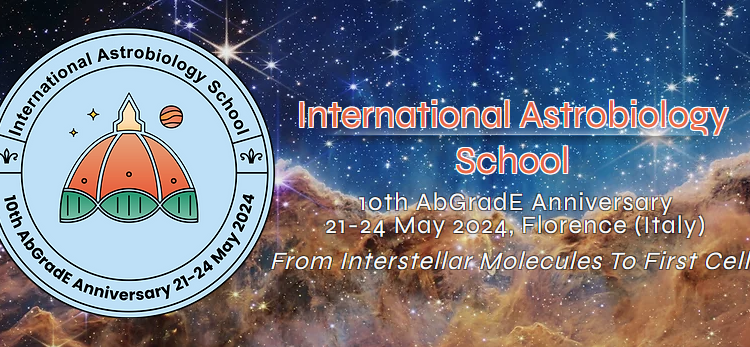
AbGradE’s 10th Anniversary – International Astrobiology School in Florence, Italy 

As of this year, AbGradE is 10 years old!🥳

We have had many really cool events, and to celebrate all these years of activity we have decided to organise our biggest event yet: a 4-day astrobiology school!

Held in beautiful Florence (Italy) May 21-24, this school is organised in collaboration with the Arcetri Astrobiology Laboratory.

At the moment, we are asking all interested people to record their interest by filling out this form by Sunday 11th of February.

🇮🇹We look forward to seeing you soon!🇮🇹

Registrations open for RED24 – An Astrobiology Introductory Course

The 2024 edition of the Rencontres Exobiologiques pour Doctorants  (RED’24 / Astrobiology Introductory Course) will take place from March 17 to 23, 2024 at the Reserve Ornithologique du Teich (France).

Its aim is to offer interdisciplinary training in astrobiology to students and young scientists with a Master’s degree in astronomy, planetology, geology, chemistry, biology, or the history and philosophy of science.

Thanks to the support of the school’s partners, they will be able to cover almost all registration costs. Participants will only have to pay for their own transport.

Lectures will be held in English.

>> Registrations are open until January 16th, 2024 <<

Discover the program and the speakers of this session on the school website

EANA 2024 – Save the Date

After a very successful EANA 2023 in Madrid, we are happy to announce that EANA 2024 will take place from September 3rd to 6th 2024 in Graz, Austria.

The conference will take place at the Graz University of Technology, hosted in collaboration with the Space Research Institute (IWF) of the Austrian Academy of Sciences (OeAW).

Please, mark the first week of September 2024 in your calendar! Further information and details will follow within the next months, so keep an eye on the EANA website.

The EAI Academy

The European Astrobiology Institute (EAI) is back for the academic year 2023 – 2024 with the third edition of the EAI Academy!

A series of 15 didactic talks and discussions by experts in the field, the seminars will once again be offered for free and will be streamed online via Zoom every two weeks on Wednesday from 3:00 to 4:00 PM CET.

The EAI Academy will provide a framework to meet online with the European astrobiology community and acquire interdisciplinary knowledge through a series of seminars given by experts in these fields.  Each session will include a 30-40 minute didactic talk followed by about 20 minutes of questions and answers.

The sessions will be hosted by the Center for Astrobiology (CAB), who will issue a certificate of participation to those who attend at least 10 seminars (remember to add your name and affiliation to the chat in order to be eligible for the certificate!).

>> Click here to learn more! <<

3 days left to complete your registration!

The deadline for registering for AbGradE’s 4th Workshop is coming up soon – this Thursday, August 31st!

You’re still in time to register, head over >> here << to fill in the form.

âť—Rememberâť—: registration is complete only after the payment of the registration fee (details will be sent in an email after we receive your registration entry).

Don´t miss out on the opportunity to discuss science with other early-career scientists!

1 month left to complete your registration!

The deadline for registering for AbGradE’s 4th Workshop is in a month – August 31st!

Head over >> here << to register.

âť—Rememberâť—: registration is complete only after the payment of the registration fee (details to be given after completing the registration form).

Don´t miss out on the opportunity to discuss science with other early-career scientists!

4th AbGradE Workshop in Madrid, Spain 

After the success of the event at BEACON 2023, AbGradE will be back for a second time this year with a workshop! 

We would like to invite you to the beautiful capital of Spain Madrid for a one-day event on September 18th (just before EANA’23).

Registration is now open, and you can find more info on the event’s page.

🇪🇸We look forward to seeing you soon!🇪🇸