Harding Essay Competition 2025

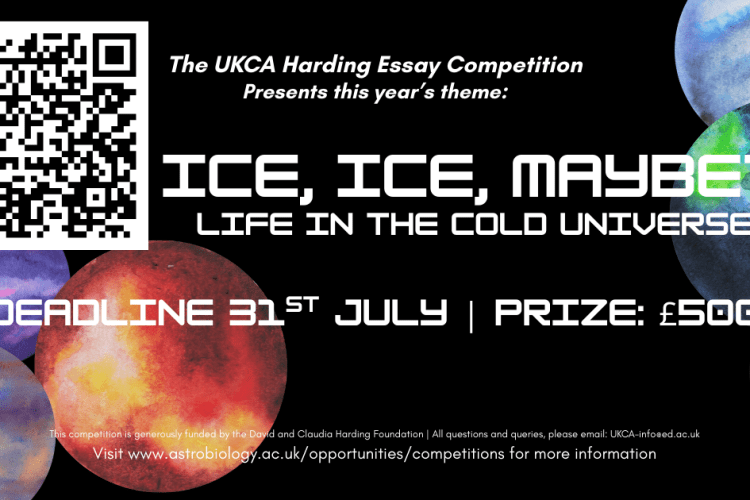
Are you a UK university student passionate about writing, science, and questioning humanity? The UK Centre for Astrobiology (UKCA) is now accepting entries for its 2025 Harding Essay Competition! This is a fantastic opportunity to showcase your perspective, get featured on the UKCA website, and win prizes.

🎓 Open to both undergraduate and postgraduate students enrolled in UK universities.

📅 Submission deadline: 31st July 2025

📩 Submit your essay to: UKCA-info@ed.ac.uk. Topics can span culture, science, society, engineering, and more — whatever sparks your voice. Visit: www.astrobiology.ac.uk/opportunities/competitions

Update on FALCON: Frontiers in Astrobiology & Origins of Life Conference

Our co-organised FALCON event (26th to 29th of June on Iceland) is only 3 months away!

Registration to our event can be done by the following link until May 31st: FALCON registration form

We want to remind you that the abstract submission deadline of March 31st is approaching soon. For more information, refer to this link: FALCON website

Travel grant applications are now open. Grants are expected to be approximately €200 – 400 (final amount may vary). Our grants are not tied to EAI membership, so you are eligible to apply even if your University is not a member of the EAI. Please send your grant application of no more than 250 words as an attachment (PDF or Word document) to abgrade@eana-net.eu. Please title the email ‘FALCON Travel Grant’ and the attachment ‘Surname_Firstname_FALCON’.

Please include the following:
1. Funds available to you via your lab group/University
2. Your nationality/background
3. Distance you will travel to Iceland
4. Confirm whether you want to do a talk or poster (or neither, i.e. simply attending)

    The deadline for travel grants is May 31st, the same day as our registration deadline. However, we will award grants on a rolling basis from next week.

    Furthermore, event organised accommodation booking deadline has been extended to April 15th, and managed through the BEACON registration platform at the following link, which is also used for the processing of all associated payments of our event: Accomodation registration (through BEACON)

    We want to remind you that on those premises, accommodation will likely still be possible for the same dates but at different rates.

    For more information please visit our event page https://abgrade.eu/falcon2025/ or send us a message via email at abgrade@eana-net.eu

    We are looking forward to meeting you on Iceland!!!

    3rd OHP International Summer School (23-27th June 2025; Observatoire de Haute Provence, France)

    Institut Origines is pleased to announce the 3rd OHP International Summer School. This exceptional event invites you to explore the frontiers of life through an interdisciplinary approach!

    Program highlights: Lectures and round-table discussions featuring renowned experts in prebiotic chemistry, microbiology, exobiology, planetology, astrophysics, philosophy, and law. These sessions will be moderated by an award-winning science journalist, offering a unique opportunity to delve into the fundamental questions surrounding the origin and evolution of life.

    Don’t miss this chance to discover the latest research and connect with scientists from around the world in a unique setting!

    Pre-register via this link: https://institut-origines.univ-amu.fr/fr/formation/ecoles-ete

    Speakers: Chantal Abergel, Mélanie Baroni, James Bradley, Jean-Michel Claverie, Magali Deleuil, Simon Duval, David Ehrenreich, Gaël Erauso, Vincent Hue, Frédéric Laurie, Dominique Leglu, Martina Preiner, Pascal Taranto, Nicolas Thouveny, and more…

    Poster credit: Sarah Anderson

    PhD Opportunity: Studying Biosignatures Under Martian Irradiation in Orléans (France)

    A PhD position at CNRS in Orléans, France, offers a unique opportunity to investigate how biosignatures survive in the harsh environment of Mars.

    Mars was once habitable, with liquid water on its surface, but over time, its atmosphere thinned, and radiation exposure increased. Despite this, ancient rocks on the Martian surface might still hold evidence of past microbial life. This PhD project will explore how cosmic radiation affects these biosignatures over billions of years, helping refine the search for life on Mars—especially for upcoming missions like ESA’s ExoMars.

    The research involves using a particle accelerator (CEMHTI Pelletron) to simulate Martian irradiation, analyzing how different minerals protect biosignatures, and collaborating with space mission teams. It’s a fantastic chance to contribute to astrobiology and planetary exploration.

    📅 Application deadline: March 14
    📍 Location: CNRS, Orléans, France

    🔗 More details & application: CNES Website

    For further inquiries, feel free to reach out to Dr. Frédéric Foucher.

    Summer School “Traces of Early Life” (3-13 June 2025 in Stirling, Scotland)

    Are you passionate about the origins of life and the search for extraterrestrial life? Join the European Astrobiology Institute’s “Traces of Early Life” Summer School, held from 3rd to 13th June 2025, at the picturesque Stirling University in Scotland. Surrounded by the stunning landscapes of Loch Ness, Ullapool, and Durness, this unique programme offers an immersive opportunity to explore the evolution of early Earth, the origins of life, and cutting-edge methods for detecting ancient lifeforms. Engage with world-leading researchers through lectures, hands-on practical exercises, and a 5-day field excursion to geologically fascinating sites.

    The school will include

    • 4 days of lectures
    • excursion to stromatolite sites and other geologically interesting locations a the stunningly beautiful North Coast of Scotland
    • practical exercises
    • poster sessions

    Whether you’re a graduate student, early-career scientist, or senior researcher, this summer school provides an exciting platform to expand your knowledge and network with experts in the field. Apply now for an unforgettable experience in one of the world’s most beautiful regions!

    See details >>here<<

    Application deadline is 1st of March 2025!

    PhD Opportunities in Interdisciplinary Space Sciences and Planetary Research in Graz (Austria)

    The Young Researcher Program YRP@Graz welcomes applications for PhD positions. YRP@Graz is jointly supported by the Space Research Institute of the Austrian Academy of Sciences, the Graz University of Technology, and the University of Graz.

    The application process has two stages with which we aim to decrease selection biases: Stage 1 of the application process is anonymised (submission deadline: March 11th 2025), stage 2 takes the form of an interview.

    Excellent candidates with a strong background in natural sciences are welcome to apply. Successful candidates must hold a master’s degree in physics, astrophysics, geoscience, computational chemistry or equivalent at the latest by the starting date of the position but preferably at the time of application. The appointment can begin July 1st 2025, and will aim for a minimum of three years.

    The five offered projects are:

    Details about the offered projects and the application process can be found here.

    Third IAGC International Conference on Water-Rock Interaction & Applied Isotope Geochemistry (16-21 June 2025)

    📅 When: 16-21 June 2025
    📍 Where: Cagliari, Sardinia
    ❗ Registration Deadline: 31 December 2024

    Get ready for an exciting gathering of global experts and researchers at the Third IAGC International Conference on Water-Rock Interaction (WRI-18) and Applied Isotope Geochemistry (AIG-15). It’s a chance to explore the latest breakthroughs, share ideas, and connect with a worldwide community.

    Why attend?
    🔹 Network with experts — Build connections and spark collaborations.
    🔹 Showcase research — Present your work and explore opportunities for publication.
    🔹 Experience Sardinia — A stunning backdrop of beaches, mountains, and rich cultural heritage.

    While you’re there, take time to soak in Sardinia’s natural beauty, explore its ancient ruins, and experience its vibrant local traditions.

    Check out the event details >>here<< and register online!

    PhD projects at the Natural History Museum in London (UK), September/October 2025

    There are two PhD projects available at the Natural History Museum, for a September/October 2025 start. These projects are in the fields of meteorites and mineralogy. Deadline for all applications is Sunday 2 February 2025, 23:59 GMT. STFC projects

    Project 1: Salt hydrates at high pressure and low temperature: Implications for icy moon explorations Contact Supervisor: Ines Collings https://www.nhm.ac.uk/our-science/study/postgraduate/phd-opportunities/projects/salt-hydrates-high-pressure-low-temperature.html

    Project 2: Petrologic and geochemical constraints on volcanic eruptions on Amazonian Mars Contact Supervisors: Chiara Petrone, Paul Schofield https://www.nhm.ac.uk/our-science/study/postgraduate/phd-opportunities/projects/petrologic-geochemical-constraints-volcanic-eruptions-amazonian-mars.html

    Full details of the application process, supervisors, and associated universities can be found on all the project pages.

    PhD projects for autumn 2025 at the AstrobiologyOU (The Open University, Milton Keynes, UK)

    The AstrobiologyOU research group at The Open University are advertising several fully funded PhD projects for autumn 2025 entry. Advertised projects span a range of disciplines and topics, and include:

    • Follow the fluids: hydrothermal alteration in Iceland and implications for Early Earth
      • Lead supervisor Dr Julia Semprich

    • Tracking the fate of ocean carbon within the ice shells of icy moons
      • Lead supervisor Dr Mark Fox-Powell

    • Exploring the contribution of meteorite impacts on the Earth’s early ocean composition
      • Lead supervisor Dr Nisha Ramkissoon

    • Pushed to the Extreme: Extremophile-Mediated Bioremediation of Smouldering Sewage Sludge Emissions
      • Lead supervisor Dr Michael Macey

    ..and others! See https://www5.open.ac.uk/research-groups/astrobiology/work-with-us/phds for more information and links to apply. Keep your eye on the page as more projects may be added in the coming weeks.