Registrations open for The RED Astrobiology Introductory Virtual School – June 10th-14th

Rencontres Exobiologiques pour Doctorants  (RED / Astrobiology Introductory Course) is a Training School about the “Basics in Astrobiology”.

This school aims to offer interdisciplinary training in astrobiology to students and young researchers with a master’s degree in astronomy, planetology, geology, chemistry, biology, or history and philosophy of science. If you are a master’s student, preparing a thesis, or are an early career scientist with a subject related to astrobiology, this training school is for you! 

Its aim is to offer interdisciplinary training in astrobiology to students and young scientists with a Master’s degree in astronomy, planetology, geology, chemistry, biology, or the history and philosophy of science.

From June 10th to 14th 2024, you are invited to participate in the Virtual RED Astrobiology School. This virtual school is based on the lectures from the “in-person” school held in Le Teich (France) in March 2024. Registering for the school will offer you the opportunity to listen to the lessons filmed on-site (given in English), interact directly with the lecturers, ask questions, and engage in conversations with other participants from all over the world!

Participants who watch the whole lecture series and succeed in short quizzes about it will receive a certificate of attendance. Live animations and Q&A sessions will be organized at CEST (UTC + 2), but you can watch the lectures and replays of the Q&A session at your convenience in your time zone.

>> Registrations are open <<

Discover the program and the speakers of this session on the school website

Summer School “Dust to DNA” in Copenhagen (Denmark)

A one-week course, aimed at PhD students, that covers the journey from interstellar dust to habitable planets and the conditions for life

Interdisciplinary lectures and hands-on sessions using perspectives from astronomy, cosmochemistry, geology, and astrobiology, within the framework of exoplanet systems and the potential for life to emerge

When: 19-23 August 2024
Where: Globe Institute at the University of Copenhagen (Denmark)

Click here for more information. 

>> Registration deadline: 31st May 2024 <<

2 weeks left to complete your registration!

(Corrected) The deadline for registering for our International Astrobiology School is in 2 weeks – March 15th (12pm CET)!

Head over >> here << to register.

❗Remember❗:

  • Please be aware that the registration does not ensure the enrolment. We would love to welcome you all! Unfortunately, the venue capacity is limited… At the end of the registration timeframe, registered people will be selected as fairly as possible across career stages and disciplines to reach the maximum number of 50 participants.
  • Enrolment is only complete following payment of the registration fee (200€). The bank details for the payment will be sent to you after the selection process.

🇮🇹 We hope to see you soon! 🇮🇹

EAI online seminar: Life on Earth, and Earth Alone: How to Make Sense of the N = 1 Problem in Astrobiology

Philipp Spillmann Department of History & Philosophy of Science University of Cambridge, UK

Tuesday, 5th March 2024, 16:00 CET (15:00 UTC)

Astrobiology is often said to be limited to a single instance of life in the universe: Life as we know it on Earth. Scientists and philosophers alike have been worried that this unfortunate predicament may lead to serious, perhaps even insurmountable obstacles to the justification of astrobiological models and theories. This concern is known as the N = 1 problem. In my talk, I take a closer look at this problem from a philosophical perspective, and analyze how exactly it is best phrased, explained, and solved – both in theory and scientific practice.

The talk will be streamed at: https://us06web.zoom.us/j/6631204351

Watch the trailer at: https://www.youtube.com/watch?v=YKnxVSsXEt8

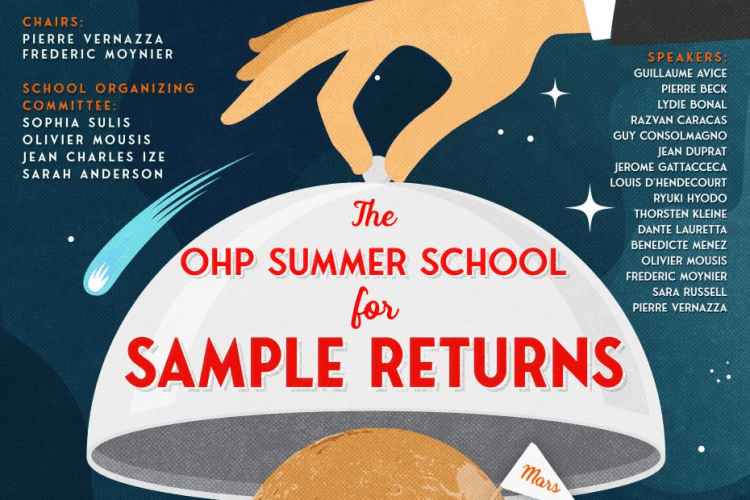
Summer School for Sample Return

This summer school, run by the Institut Origines at Aix-Marseille University and the Origins theme from the Institut de Physique du Globe de Paris, will provide a unique platform to access both basic and cutting-edge knowledge related to the study of the origin of terrestrial planets and life based on the analysis of extraterrestrial samples in Earth laboratories.

There will be a particular focus on recent and future sample return missions. This multidisciplinary summer school will address domains including cosmochemistry, astrobiology, astrophysics, planetology, and more. You will learn through lectures and practicals from our large set of world experts as well as from more informal exchanges through a series of round tables with dedicated topics.

When: 24-28 June 2023
Where: Observatoire Haute-Provence, France

Click here for more information. 

Summer school Exoplanets by the Lake II: Geoastronomy

Exoplanets by the Lake II: Geoastronomy is a focused summer school on the geosciences of exoplanets at Lake Ammer (Ammersee), July 21—26 2024.

The distinctive features of the summer school include:

  • Emphasis on in-person interaction at an attractive, self-contained venue with at most 20 participants. The number of participants is kept small in order to encourage unrestricted, interactive discussions among exoplanet scientists of all sub-disciplines and seniority.
  • The event will be held for 5.5 days (5 nights). The first 3 weekdays involve pedagogical lectures during the day. There is an optional half-day excursion, via ship on the lake. The last 2 days feature a mini-conference format, where a small number of invited experts share their views and interact with the participants. Participants have the chance to contribute short talks if desired.


The intended audience of this summer school ranges from master students to junior postdocs. Both experts and curious newcomers to the topic are welcome to attend. Senior scientists who are intending to switch research directions and/or attending as active listeners are also welcome.

>> Deadline for registering: March 31st <<

You can visit the page of the school here for more information. 

EAI online seminar: How life-like functions can emerge spontaneously in chemical networks

Sijbren Otto, University Of Groningen Centre For Systems Chemistry, Stratingh Institute, The Netherlands

Tuesday, 6 February 2024, 16:00 CET (15:00 UTC)

Abstract: While a lot of research is devoted to the search for the chemical building blocks of life in prebiotic settings, relatively little attention has been paid to how the functions of life can emerge from mixtures of lifeless molecules. In this seminar I will introduce you to simple mechanisms through which several functions, that are deemed essential to life, can emerge from simple chemical reaction networks. These functions include self-replication, followed by catalysis and how this can lead onto a primitive metabolism. Catalysis can also yield cell-like compartments to house the self-replicators. Under the right conditions the resulting systems can undergo rudimentary Darwinian evolution and exhibit life-like behavior, including niche partitioning and eco-evolutionary dynamics

The talk will be streamed at: https://us06web.zoom.us/j/6631204351

Watch the trailer at: https://youtu.be/OQmH33FU5uY

Nuclear astrochemistry workshop

The first meeting on Nuclear astrochemistry is being held under the auspices of the European Centre for Theoretical Studies in Nuclear Physics and Related Areas (ECT*) in Trento (Italy) from February 26th to March 1st.

This brings meeting together disparate fields of nuclear physics with the rapidly emerging field of astrochemistry to explore the processes of star formation (and death) and planet formation and how they create the conditions that may allow life to evolve and be sustained. In the workshop, the first of its kind, we will bring together leading experts in these fields together with early career researchers who will develop this new field through observations (using JWST), theoretical models and simulations, and laboratory studies (including meteorites) to address the fundamental questions of how the elements and molecules of life are created in the universe and the consequences for the search for life beyond Earth and our solar system.

There’s funding available for both senior and Early Career Researchers (ECRs) to attend the meeting with meals and accommodation included at the ECT  Villa Tambosi in Trento Italy. All ECRs are invited to present a talk at the meeting and participate in discussions leading to future initiatives for interdisciplinary projects.

>> Deadline for registering: January 31st <<

You can visit the page of the school here, and you can contact Prof Nigel Mason for further details. 

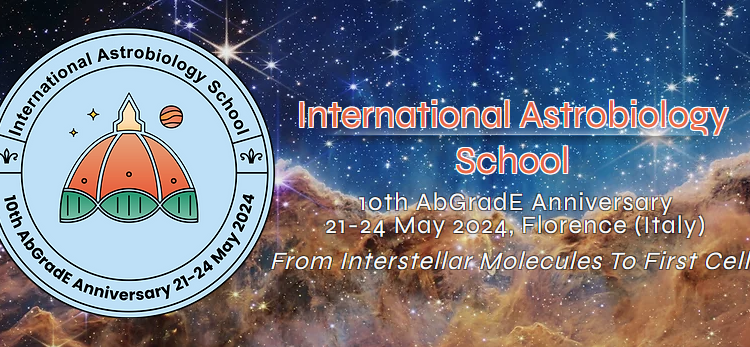
AbGradE’s 10th Anniversary – International Astrobiology School in Florence, Italy 

As of this year, AbGradE is 10 years old!🥳

We have had many really cool events, and to celebrate all these years of activity we have decided to organise our biggest event yet: a 4-day astrobiology school!

Held in beautiful Florence (Italy) May 21-24, this school is organised in collaboration with the Arcetri Astrobiology Laboratory.

At the moment, we are asking all interested people to record their interest by filling out this form by Sunday 11th of February.

🇮🇹We look forward to seeing you soon!🇮🇹