Workshop: Microsatellites and their use in planetary and astrobiology research

Running in Tartu (Estonia) from the 1st to the 8th of August 2023, this workshop will enable students and early career scientists to design micro- and nanosatellite missions tackling scientific themes and target objects they have chosen themselves previously. The workshop will consist of three parts:

  • a lectured part consisting of in-depth talks on the scientific background of the chosen mission themes and on important issues in satellite technology
  • a mission designing part where attendees plan these endeavours in detail with the help of satellite technologists
  • a final presentation of all the projects

In order to plan missions involving such small satellites successfully, intensive interaction and cooperation between scientists and space technologists are necessary, which is still lacking in some potential key applications. The workshop school aims to:

  • Highlight the possible potential of microsatellites in exploring different targets like the Moon, small bodies and outer satellites
  • Foster the interaction between space researchers and technologists
  • Allow participants to start the design and planning of new space missions
  • Contribute to the training of a new generation of space researchers

The work on the mission designs will continue after the workshop, thus ensuring a long-term impact.

The European Astrobiology Institute, University of Tartu and Stockholm University Astrobiology Centre will function as co-organisers of the workshop.

The workshop will consist of lectures by leading scientists, planning for different micro- or nanosatellite projects in small groups, as well as open discussions. Participants will also have the possibility to display their own research results in a poster session. Furthermore, a one-day excursion to South Estonia and a walk around Tartu are included as a social programme.

For further information, please check the website.

Conference “Life in the sub-surface”

The meeting “Life in the Sub-Surface: Habitats, species, metabolism and survival strategies” organised by the EAI will take place in Angra (in the Azores Islands, Portugal) from the 25th to the 27th of October 2023. It will focus on the following subjects:

  • Characteristics of (potential)  sub-surface habitats on Earth and beyond
  • Early evolution of subsurface life including its possible role in emergence of life
  • Diversity, metabolism and survival strategies of subsurface life on Earth
  • Possibility of extraterrestrial subsurface life and its detection
  • Gaps in the knowledge about subsurface life
  • Subsurface environments and extremophiles on the Azores.

 It will be held at the very modern Centro Cultural e de Congressos offering
ideal setting. The location Angra (in the Azores Islands, Portugal) is a picturesque city and has plenty of good restaurants and clean and affordable hotels with good
services.

The EAI project team “Astrobiology and Art” will organise a multimedia event on the first day. The speleological society “Os Montanheiros” will organise an exhibition of life in Azorean lava caves.

 >> The deadline for registration and abstract submission is July 1st,
2023 <<

Please check the website for more info.

Summer school “Volcanism, Plate Tectonics, Hydrothermal ventsand life”

The summer school organised by the EAI will focus on which role volcanism, plate tectonics and hydrothermal vents played in the emergence and evolution of life.
There will be lectures by leading scientists in the field, sampling excursions to lava caves and solfatares, exercises on the genetic characterisation of
extremophiles populations
in those habitats, as well as on cultivation of
bacteria
.

The summer school will take place in Angra (in the Azores Islands, Portugal) from the 11th to the 21st of October 2023. There
are flights to the close Terceira Lajes airport from both Europe
mainland, the US and Canada.

The summer school will include:

  • Lectures by leading scientists in the field covering a cornucopia of different subjects
  • Field excursions to geologically interesting sights (volcanic areas, hot springs, lava caves, etc.)
  • Exploration of lava caves
  • Characterisation of microbes in lava caves and hot springs via Polymerase chain reaction (PCR)
  • Poster sessions
  • Participant-led discussions

 >> The deadline for applications is July 1st, 2023 <<

Please check the EAI website for more info

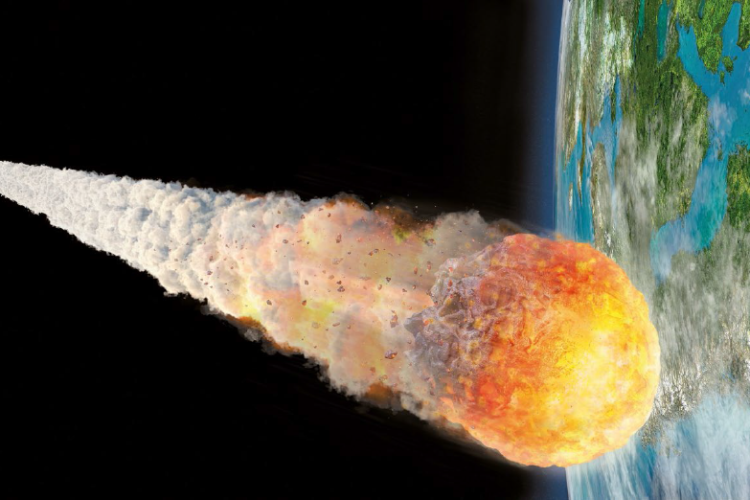
Summer school “Impacts and their Role in the Evolution of Life”

The course organised by the EAI will give the participants a thorough introduction into
how meteorite, comet and asteroid impacts participate in shaping
life on Earth
. The following subjects will be covered by the lecture:

  • Roles of impacts in the formation of habitable planets
  • Physical and chemical properties of comets and meteorites
  • Detection and investigation of impact craters by geological meth and remote sensing from space
  • Ecological consequences of impacts and the role of impacts in mass extinctions
  • Transfer of life through meteorite impacts
  • Threat of life on our planet by near-Earth asteroids and comets

The lecture programme will be complemented by practical exercises concerning:

  • Investigations of Suevite formations
  • Analysis of pollen indicators impacts events.
  • Microscopy of impactites
  • Outreach work for a conference on â€śImpacts and their role in the evolution of life” in Nördlingen in autumn 2024

 The summer school will be held in Nördlingen (Germany), the centre of the Ries Crater impact, from the 5th to the 14th of September 2023.

Lectures will cover a cornucopia of subjects ranging
from properties of impactors, physics of impacts, ecological
consequences of impacts, impact geology to impacts on Mars. Exercises
will comprise geological field studies at the Ries and the
neighbouring Steinheim crater as well as palynological and
petrographic microscopy studies.

Many leading scientists will teach a
the school.

Bursaries are available for students and early-career scientists.

Nördlingen is a very nice medieval city situated on the
“Romantic Road” with an intact city wall and offers good
accommodation and meals. It is easy to reach from the international
airports from Munich and Frankfurt as well as by train.

 >> The deadline for applications is 15 June 2023 <<

Please check the EAI website for more info

AbGradEPEC 2023 is in almost 1 week!

We are really looking forward to finally having this long-awaited event in La Palma🌴

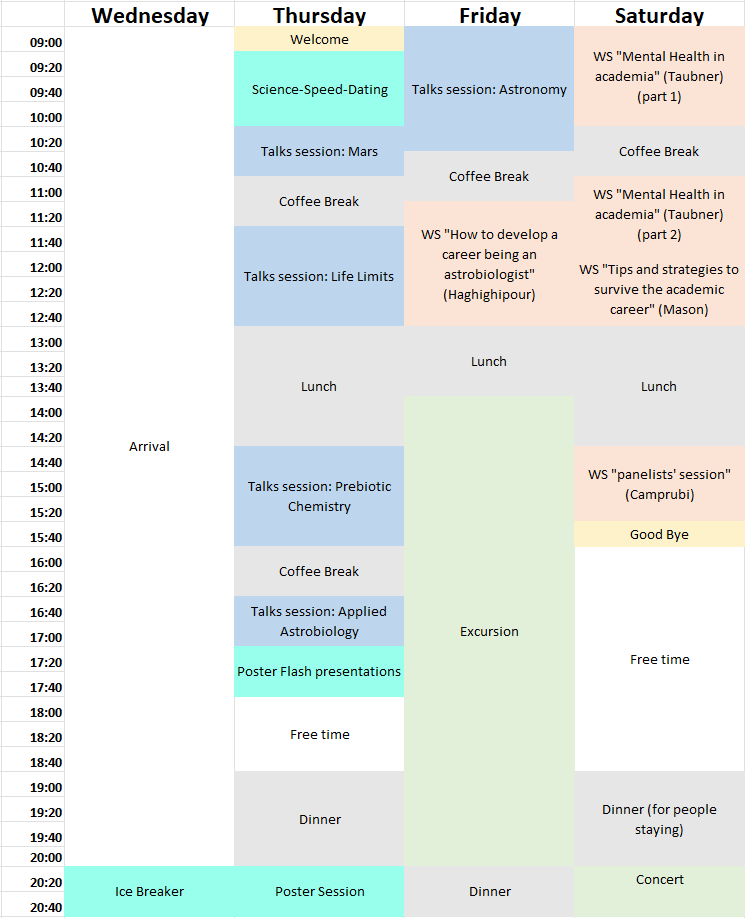
Here is the programme, packed with interesting talks, workshops and fun activities:

All participants should expect one last email from us with more practical details and the Symposium Bookletđź“–

We’ll see some of you soon, and hopefully we’ll be able to meet those who couldn’t join us this time at our next events!

18th Heidelberg Summer School – Call for Applications

The “International Max Planck Research School for Astronomy &
Cosmic Physics at the University of Heidelberg
” (IMPRS-HD)

announces the

>> 18th Heidelberg Summer School <<
“Unraveling Galaxy Evolution with JWST”

The school is organized for early-career scientists and will take place on September 4 – 8.

It will focus on the most relevant aspects of galaxy evolution addressed by JWST, from nearby to the most distant galaxies.
JWST revealed surprises from its first images and is already
revolutionizing many fields of astrophysics.

The school will give the participants an overview of what we have learned about galaxy evolution in the first year of JWST observations, the emerging challenges, and the opportunity to work with JWST data guided by world-renowned experts.

The topics include an overview of JWST, the physics of nearby galaxies, the role of AGN feedback, the cosmic noon, and the high-z Universe.
The lectures will be accompanied by hands-on sessions and talks highlighting recent scientific results.

Invited lecturers are:

Steve Finkelstein (Univ. Texas Austin)
Adam Leroy (Ohio State Univ.)
Nora LĂĽtzgendorf (ESA)
Alice Shapley (UCLA)
Andrey Vayner (Johns Hopkins Univ.)

Hands-on session tutors are:
James Davies (MPIA)
Oleg Egorov (ARI)


The school SOC is:
E.Banados (MPIA), L.Boogaard (MPIA), F.Davies (MPIA), A.de Graaff (MPIA),
I.Momcheva (MPIA), N.Neumayer (MPIA), D.Wylezalek (ZAH)

>> Deadline for applications is June 15, 2023 <<

Registrations open for the Space Science in Context (SSiC) online conference

Join on the 26th January 2023 the Space Science in Context (SSiC): a FREE online conference that unpacks the social dimensions of outer space.

There will be three panels of invited speakers who will be live in conversation – on Space and the Environment; Space, Technology and Dual-Use; and Labour and Space – packed with wonderful speakers, and two poster sessions of contributions from around the world on how space interacts with local social contexts. 

The schedule, programme and more information about SSiC is available online at spacescienceincontext.com, and from Thursday 19th January the prerecorded talks and posters are available online to registrants. 

Register for the conference and gain access to their pre-recorded content and the live panels, for free, here.

They will be providing English-language CART for the three speaker panels and one poster room in each session, with auto-captioning available for the poster sessions. Further, all attendees, invited speakers, and poster presenters are required to comply with the accessibility statement and code of conduct. If you would like more information about accessibility, including how to use Zoom’s accessibility features, or safety please reach out to the organisers at spacescienceincontext(at)gmail.com.

Space Science in Context 2023 is only possible thanks to the financial support of the Royal Astronomical Society’s Meeting Grant; and the European Association of Science and Technology Studies (EASST) Fund. SSiC is and will always be free to attend. If you would like to donate to support SSiC and our mission to pay speakers and build accessible, interdisciplinary platforms, consider buying them a Ko-Fi!

Registrations open for RED23 – Astrobiology Introductory Course

The 2023 session of the Rencontres Exobiologiques pour Doctorants  (RED’23 / Astrobiology Introductory Course) will take place, if sanitary conditions allow, from March 12 to 18, 2022 at the Reserve Ornithologique du Teich (France).

These meetings are organized for:

  • Any student preparing a thesis in Earth and Universe Sciences, Chemical Sciences, Life Sciences, Bioinformatics or History / Philosophy of Sciences.
  • Students wishing to acquire an interdisciplinary training in astrobiology to complete their initial training and to be able to address questions related to the origins of life on Earth and beyond, its evolution and its distribution in the Universe.
  • The school is also open to any young researchers interested in astrobiology

The RED’23 / Astrobiology Introductory Course program is complementary to the RED’22 program, however it is not necessary to have attended in 2022 to participate in this new school.

Lectures will be held in English.

Registrations are open until January 31, 2023. Some grants to participate are available, more about it on the website.

Discover the program and the speakers of this session on the school website